
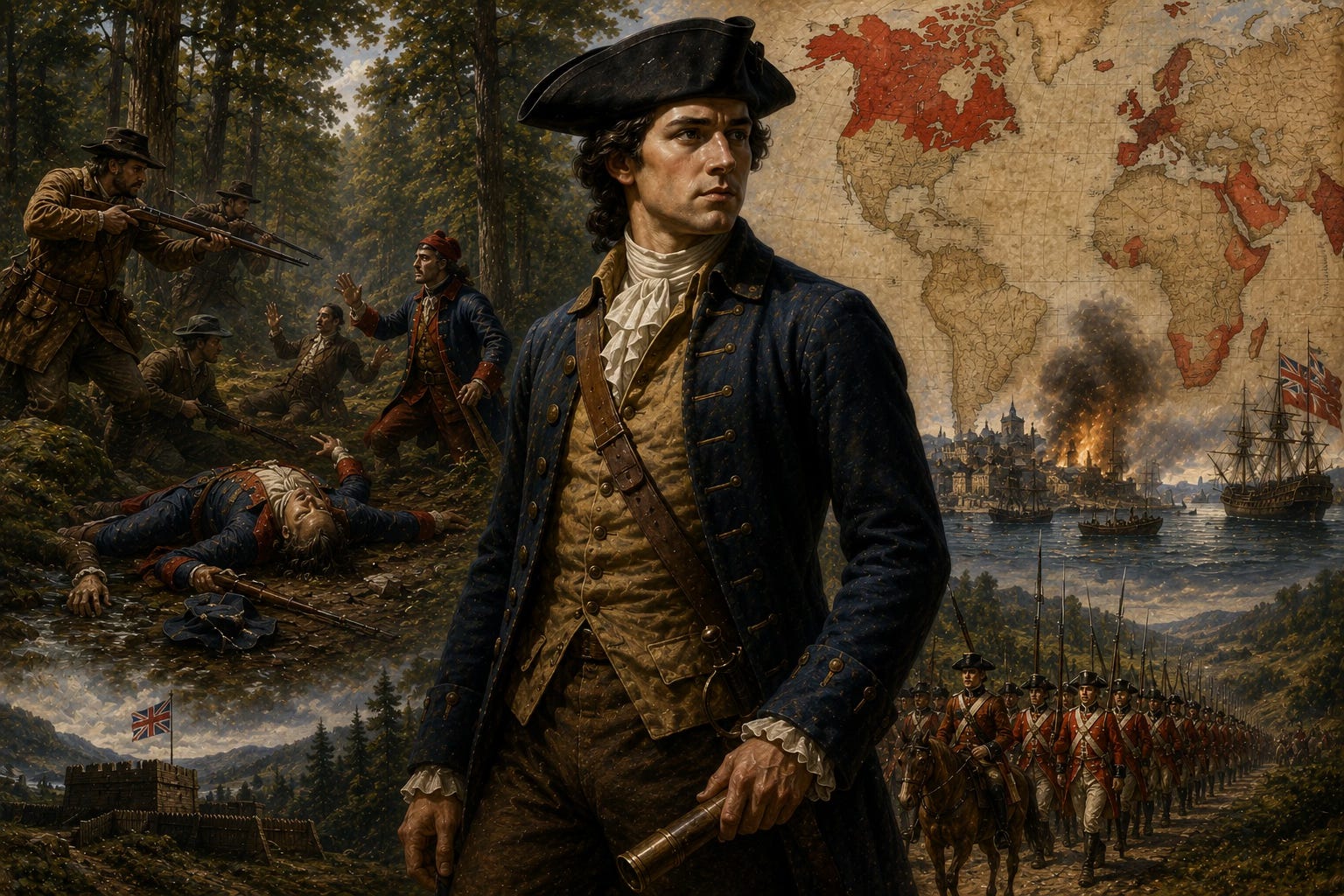
May 28, 1754
Before George Washington became the indispensable man of the American founding, he was a 22-year-old militia officer deep in the Ohio wilderness making decisions far beyond his understanding. Which, to be fair, is usually how history usually works.
Modern Americans tend to imagine the Revolution beginning cleanly in 1775 or 1776 — Lexington, Concord, the Declaration. But the road to independence began much earlier.
And strangely enough, it began with a skirmish in the forests of western Pennsylvania that helped trigger a global war. The incident became known as the Jumonville Affair.
Virginia’s royal governor, Robert Dinwiddie, had sent Washington into the contested Ohio Valley. Britain and France were both claiming the territory, and tensions were escalating rapidly.
Neither empire fully controlled the frontier. Since neither empire fully controlled the frontier, young officers suddenly found themselves making geopolitical decisions with incomplete information and loaded muskets.
Washington and his men discovered a small French detachment under Joseph Coulon de Jumonville camped in a ravine.
Accounts of what happened next remain disputed to this day. What is clear is that shooting erupted. Jumonville was killed and the fragile balance between Britain and France in North America shattered.
The consequences spiraled outward quickly. The French and Indian War erupted in North America. Then the conflict expanded globally into what historians now call the Seven Years’ War — fought across Europe, the Caribbean, Africa, India, and the Atlantic.
In many ways, it became the first true world war. Britain eventually won, but victory came at enormous cost. It’s national debt exploded, more than doubling from the war.
In response, the British government concluded the colonies should help pay for imperial defense.
That logic produced:
the Stamp Act,
the Townshend Acts,
the Tea Act,
and eventually the imperial crisis itself.
In other words: the road to American independence runs directly through the ambitions and mistakes of empire. And standing near the beginning of that road was a very young George Washington learning lessons that would shape him permanently.
Because Washington did not emerge from the wilderness as a romantic revolutionary.
He emerged deeply aware of:
military weakness,
logistical reality,
imperial arrogance,
and the chaos that follows political miscalculation.
The frontier hardened him. It also humbled him. At the Battle of Fort Necessity shortly after the Jumonville affair, Washington suffered defeat and signed surrender terms written in French that may have unintentionally implicated him in an “assassination.”
Not exactly the polished beginning of a Founding Father. Which is precisely why the story matters. The founders were not mythological figures descending fully formed into history. They learned through failure, improvised through crisis, adapted under pressure.
Washington’s early experiences taught him something that later defined both his military leadership and his presidency: emotion and pride do not alter reality. Logistics matter. Preparation matters. Structure matters.
And empires often collapse less from outside attack than from internal pressures, overextension and accumulated debt.
That lesson would return twenty years later when Britain tried to tighten control over the colonies to recover the costs of imperial war. The irony is almost perfect: Britain won a world war — and in doing so created the conditions for losing America.
And a young Virginian officer helped light the fuse long before he understood where the explosion would lead.
Excellent story! Thank you!