
Everyone knows July 4.
Almost nobody knows August 2, which is the date that actually required courage.
On July 4, 1776, the Continental Congress formally adopted and approved the text of the Declaration of Independence and sent it to a printer. What came off John Dunlap’s press that night were broadsides — announcements, bearing only two names: those of the president of Congress, John Hancock and its secretary, Charles Thomson.
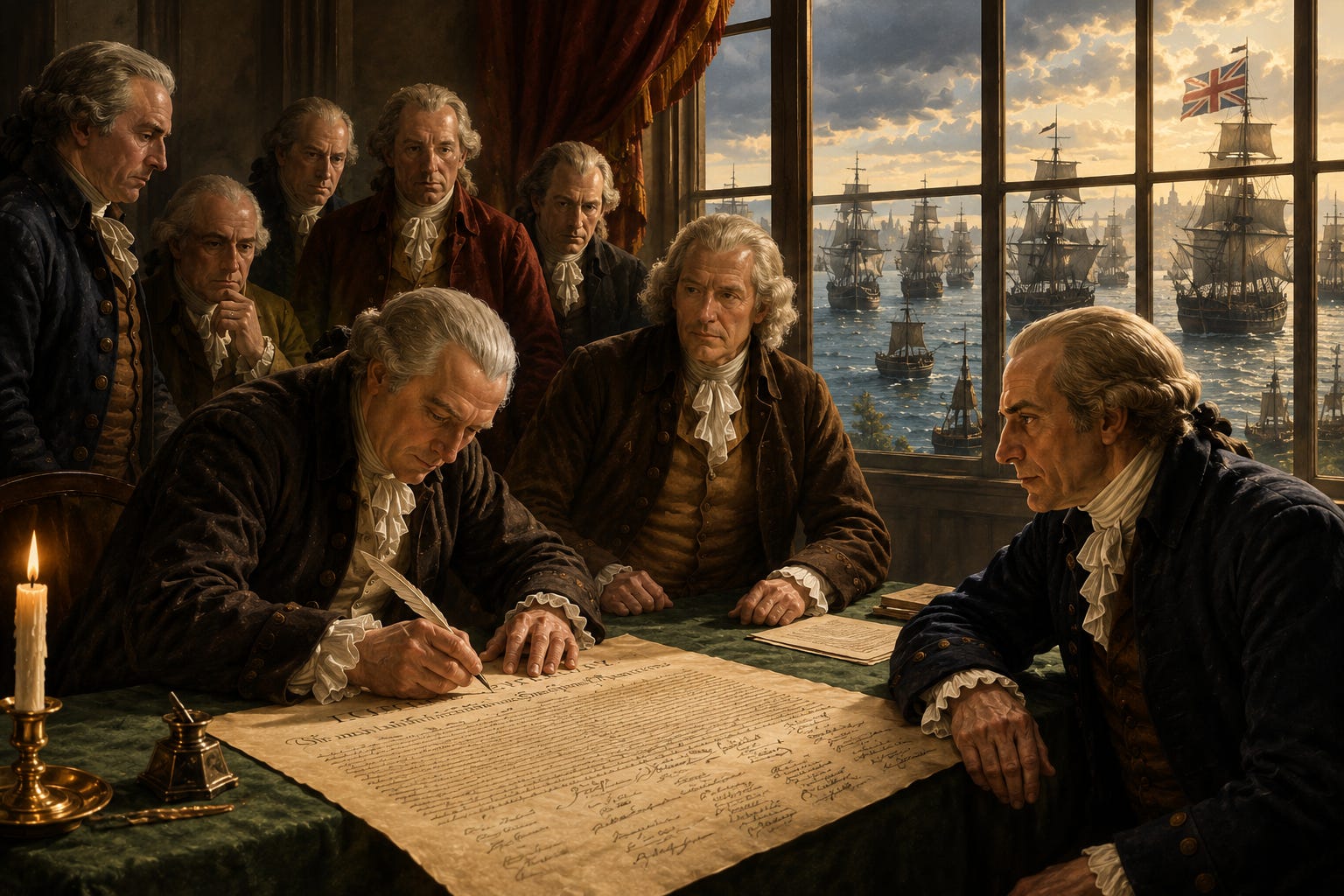
The document with the signatures on it, the engrossed parchment that resides in the National Archives in Washington DC today, was not ready until the end of the month. Most of the delegates put their names to it on Thursday, August 2, 1776.
Four weeks had passed. In those four weeks, their situation had changed completely.
Beginning in late June and continuing all summer, the sails had been appearing off Sandy Hook in the New York City area.
First a few. Then dozens. Then more ships than anyone in America had ever seen in one place; hundreds upon hundreds.
The Empire had returned in force.
By August, General William Howe and his brother, Admiral Richard Howe, had assembled somewhere in the neighborhood of four hundred vessels and more than thirty thousand troops in and around New York Harbor — British regulars and sailors along with Hessian mercenaries, professional mercenaries hired by the Crown to put down the rebellion.
It was the largest expeditionary force in the history of Great Britain.
The Americans could count. Ships were visible from the shore. Washington’s army in New York numbered perhaps twenty thousand men on paper, many of them militia, poorly trained, badly equipped, and already sick.
There was no ambiguity left. In July, independence was a proposition. In August, it was a wager against a massive invasion force you could see from the beach.
That is the context for the signing. The men who walked up to the desk in Philadelphia and picked up the pen knew what was anchored off Staten Island.
Benjamin Rush was there, and years later he wrote down what the room was like.
He remembered silence. He remembered gloom. He remembered men going up one at a time, in what he described as the pensive and awful manner of subscribing to their own death warrants.
And he remembered the one moment of levity, which is one of the blackest jokes in American history.
Benjamin Harrison of Virginia was a large man — genuinely large, a heavy Tidewater planter. Elbridge Gerry of Massachusetts was small and slight.
Harrison turned to Gerry and observed that he would have a considerable advantage when they all hanged for what they were doing that day. His own weight would finish him in a moment. Gerry, being so light, would dance in the air for an hour or two before he was dead.
Rush recorded that Harrison’s words produced a transient smile from Gerry.
Think about the mechanics of that joke. It is not gallows humor in the loose modern sense. It is a technically accurate observation about drop weight and asphyxiation, delivered between two men who had a realistic expectation of experiencing it.
They were not being dramatic. Treason against the Crown carried a defined and gruesome penalty, and the man authorized to impose it had just parked over thirty thousand sailors and soldiers in their largest harbor.
A few things worth knowing about that parchment.
Not everyone signed on August 2. Some delegates were absent and signed later in the fall. Matthew Thornton of New Hampshire was not even elected to Congress until September and added his name in November. A few signers had not been present for the July vote at all.
And Congress kept the list secret for months. The full roster of names was not published until January of 1777 — after Trenton, after there was something resembling good news.
That detail is easy to read cynically. Read it correctly instead. It means these men understood precisely what a signed list of names would be worth to a British provost marshal, and they signed anyway.
Roughly a third of them paid for it. When they pledged their lives, their fortunes and their sacred honor, they meant it in the truest sense: Homes were burned, estates seized, sons killed, fortunes gone. Several were captured. One, Richard Stockton of New Jersey — a College of New Jersey man, a John Witherspoon colleague — was dragged from his bed, imprisoned, and never recovered his health.
Here is the thing to hold onto: we tend to treat the founding as inevitable because we know the ending. We read the Declaration as a birth announcement.
It was not. On August 2, 1776, it was closer to a death warrant that our Founders willingly chose to sign because they believed in something worth dying for.
The men who signed it had no assurance of Saratoga, no assurance of the French alliance, no assurance of Yorktown. What they had was an argument about the nature of legitimate authority, an army they suspected was up against enormous odds, and a vast fleet visible on the horizon.
And they still signed. And then twenty-five days later the British landed on Long Island and very nearly ended the war.
If you enjoyed this article, you’ll love the documentary.
Thread of Liberty follows the entire thread of the American experiment — from ancient Rome and the Puritans, through the Revolution and the Constitution, to Tocqueville, Lincoln, Calvin Coolidge, and the modern Administrative State.
Watch the full feature documentary at ThreadofLiberty.com