
English treason law required two witnesses.
The Crown had one against Algernon Sidney — a man of poor character testifying to save his own neck. So the prosecution produced a second witness of a novel kind.
They produced the defendant’s own handwriting.
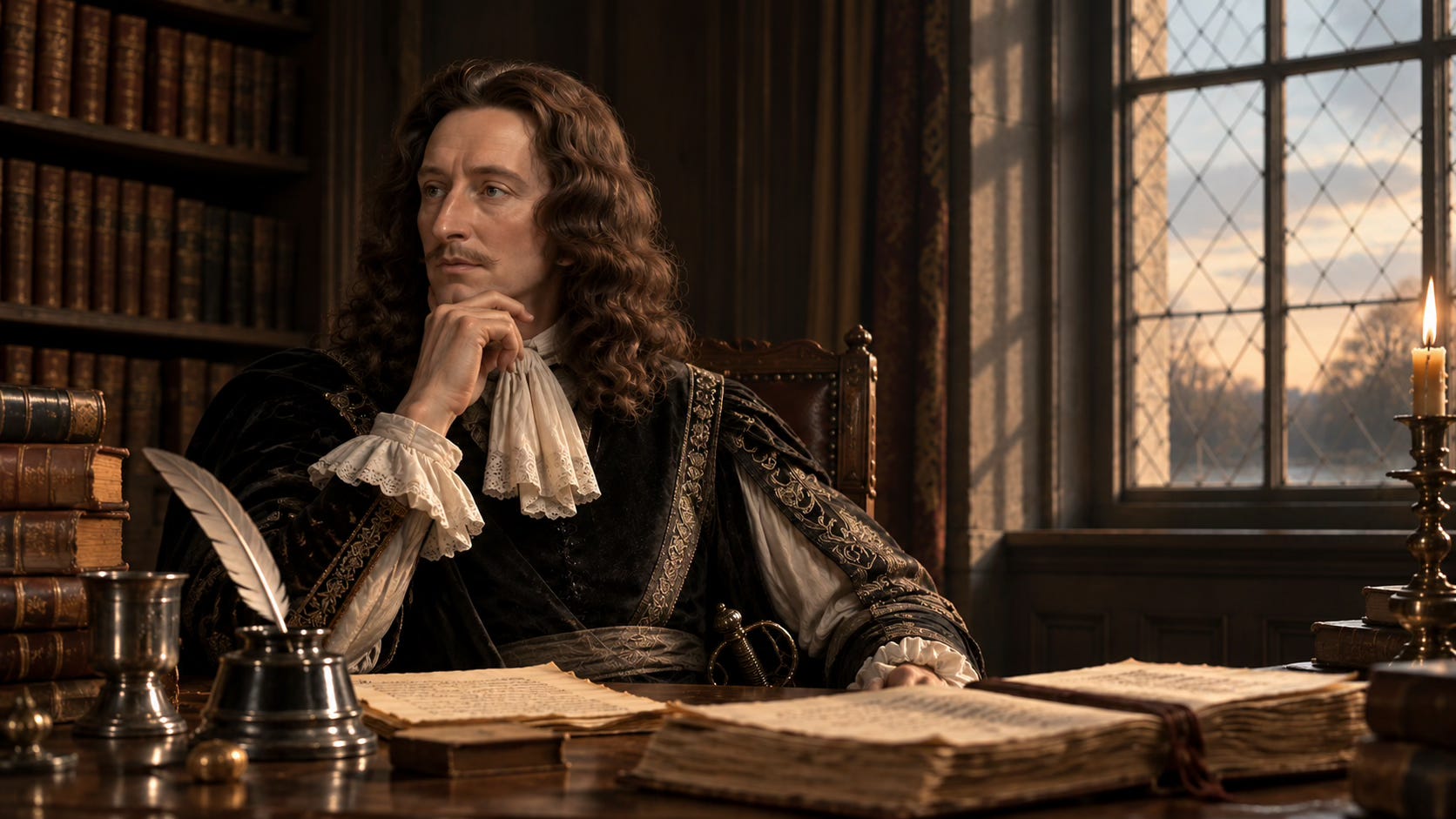
Papers had been seized from Sidney’s study: a long, unfinished, unpublished manuscript arguing that political authority derives from the people, that a ruler who breaks his trust may lawfully be resisted, and that no man is born with a right to govern another.
Nobody had read it. He had shown it to no conspirators. It was a book in progress, sitting on a desk.
The Lord Chief Justice, George Jeffreys — a name that still carries a stench in English legal history — instructed the jury on the point of law that made the conviction possible. To write is to act. The court decided that the unpublished manuscript counted as the second witness.
Sidney was beheaded on Tower Hill on December 7, 1683.
He had been an odd man and a difficult one — a colonel in the parliamentary army during the civil wars, a republican who refused to serve Cromwell once Cromwell became a king in everything but name, a long exile who spent decades on the continent rather than come home to the Restoration. He was proud, quarrelsome, and incapable of the strategic silence that keeps men alive in dangerous times.
His motto, which he wrote in a visitors’ album in Copenhagen and which got him into trouble even then, translates roughly as: This hand, hostile to tyrants, seeks with the sword a quiet peace under liberty.
The second half of that line is the motto of the Commonwealth of Massachusetts. It is on the state seal today.
The manuscript that killed him was published nine years after his death as the Discourses Concerning Government, and it became one of the most important political books in colonial America.
It was written as a demolition of Robert Filmer’s Patriarcha, a defense of absolute monarchy that argued kings inherit their authority from Adam’s dominion over his family — that political power is simply fatherly power, scaled up, and that talk of consent is therefore incoherent.
Filmer was the target John Locke was demolishing at the same moment in his own first treatise. Two men in the same city, in the same danger, taking apart the same book. Locke fled to Holland and survived. Sidney did not.
Sidney’s answer runs along lines that should now be familiar from Rutherford and from Coke.
Government exists for the good of the governed, not the glory of the governor. Its authority is delegated and conditional. Liberty consists in living under laws made with your consent rather than under the will of another man, however wise or benevolent that man may be. A magistrate who breaks the conditions has dissolved his own commission, and resistance to him is not rebellion.
And, most sharply: a people may change what a people established.
Americans in the 1760s and 1770s read Sidney alongside Locke, and often preferred him. Locke is careful, systematic, and academic. Sidney’s passion and fury come off the pages. He writes like a man who has watched friends die and expects to join them, which he had and did.
Colonial newspapers ran his arguments. Pamphleteers borrowed his lines. When Jefferson and Madison later drew up a reading list for the University of Virginia’s course on government, they named Locke and Sidney together as the elementary books of public right — the two texts that set out the general principles of liberty and the rights of man.
Jefferson also said, in old age, that the Declaration was not meant to be original — that it was an expression of the American mind, drawing on the elementary books of public right, and he named Sidney among them.
Now consider the two facts side by side.
A book was used as a witness against its author and he was killed for it. That same book was, ninety years later, one of the acknowledged sources of the American Declaration of Independence.
This is the second time in this series that a manuscript has ended up on a scaffold. Rutherford’s Lex, Rex was burned by the public hangman in Edinburgh, and its author died under a treason summons. Sidney’s Discourses was read into evidence and its author was beheaded.
Both books said essentially the same thing: the law is above the ruler, and authority that violates its trust forfeits its claim.
Both governments understood the argument perfectly well, which is why they reached for the executioner rather than the printing press.
There is a lesson in that about the seriousness of ideas, and Americans in a comfortable age are not well positioned to feel it.
We treat political argument as entertainment — as content, as a way of signaling which team we are on. The men who built the intellectual foundation of this country treated it as something you could be killed for, because they were, repeatedly, and they wrote anyway.
Sidney’s trial has one final irony worth noting.
Five years after he died, James II was driven from the throne in the Glorious Revolution, and the Parliament that replaced him did so on grounds that Sidney would have recognized instantly: that the king had broken the original contract between king and people.
The doctrine he was beheaded for became the official justification of the English state within half a decade. His attainder was reversed. The argument won. He was simply early, which sadly in politics is frequently indistinguishable from being wrong.
If you enjoyed this article, you’ll love the documentary.
Thread of Liberty follows the entire thread of the American experiment — from ancient Rome and the Puritans, through the Revolution and the Constitution, to Tocqueville, Lincoln, Calvin Coolidge, and the modern Administrative State.
Watch the full feature documentary at ThreadofLiberty.com