
If you want to understand why America worked—why it still works when it works—you have to start with an obvious fact:
Americans were practicing self-government long before they declared independence.
They weren’t perfect at it. They weren’t consistent. They weren’t always fair.
But they had something most nations don’t get until much later: reps. Lots of reps on how to self-govern.
Self-government is not a mood. It’s a skill that needs to be practiced over and over again.
And the American colonies were a training ground for that skill.
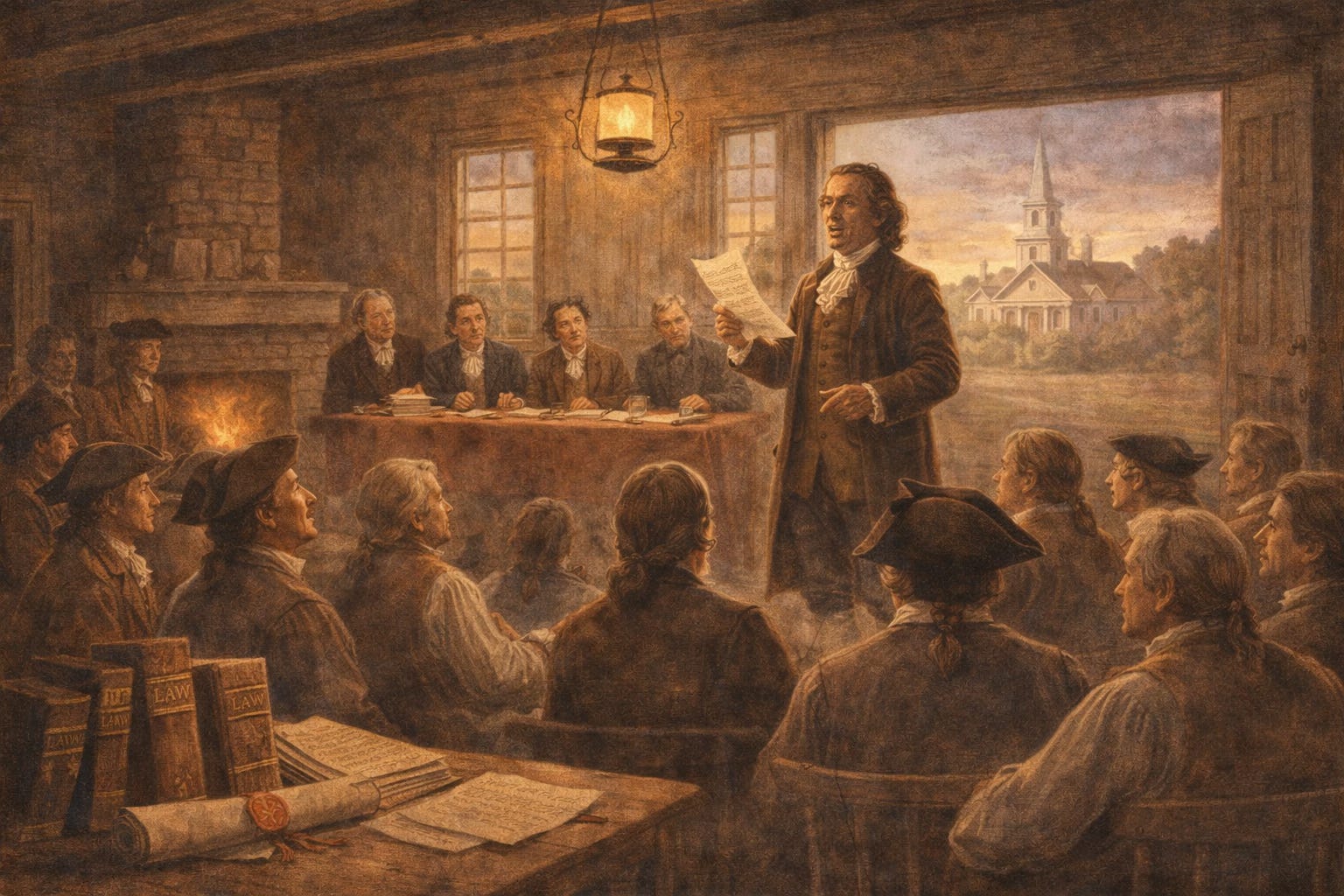
New England town meetings weren’t just quaint scenes for history documentaries. They were laboratories of democracy, as Tocqueville put it—places where ordinary people argued about roads, taxes, schools, and rules.
Not glamorous. Yet extremely consequential.
Because when people govern the small things, they learn how to govern the big things.
Colonial legislatures pushed and tested the boundary between local authority and imperial control.
And over time, English liberties began evolving into something sharper:
American rights.
This is where Whig theory hit American soil and changed.
Because theory always changes when it meets reality.
The colonies took inherited ideas—rights, consent of the governed, representation—and tested them in real life. When those ideas were violated (in their view), they reacted not as rebels at first, but as people defending an existing order.
Samuel Adams.
James Otis.
Patrick Henry.
Joseph Warren.
Different temperaments, same underlying claim:
We are not children.
We are not subjects without standing.
We are not the property of Parliament.
And Tocqueville, arriving later, recognized the result: Americans didn’t treat government as something done to them. They treated it as something they did.
That’s the seed of the American miracle. Not the myth. The miracle.
Because when a people has the habit of self-rule, it can survive crises that crush other nations.
But this practice also carried a danger: once people learn they can act, they can also act foolishly.
Which is why you need institutions that assume human nature is… human.
That takes us to the crisis: when theory became revolution.
Self rule is the first law of all breath-life. Our perspective first,our insight before that! Then all else comes after. I see many that have had their perspective shaped by another,not perceiving themselves,they live a hollow life,an imitation of self identity.