
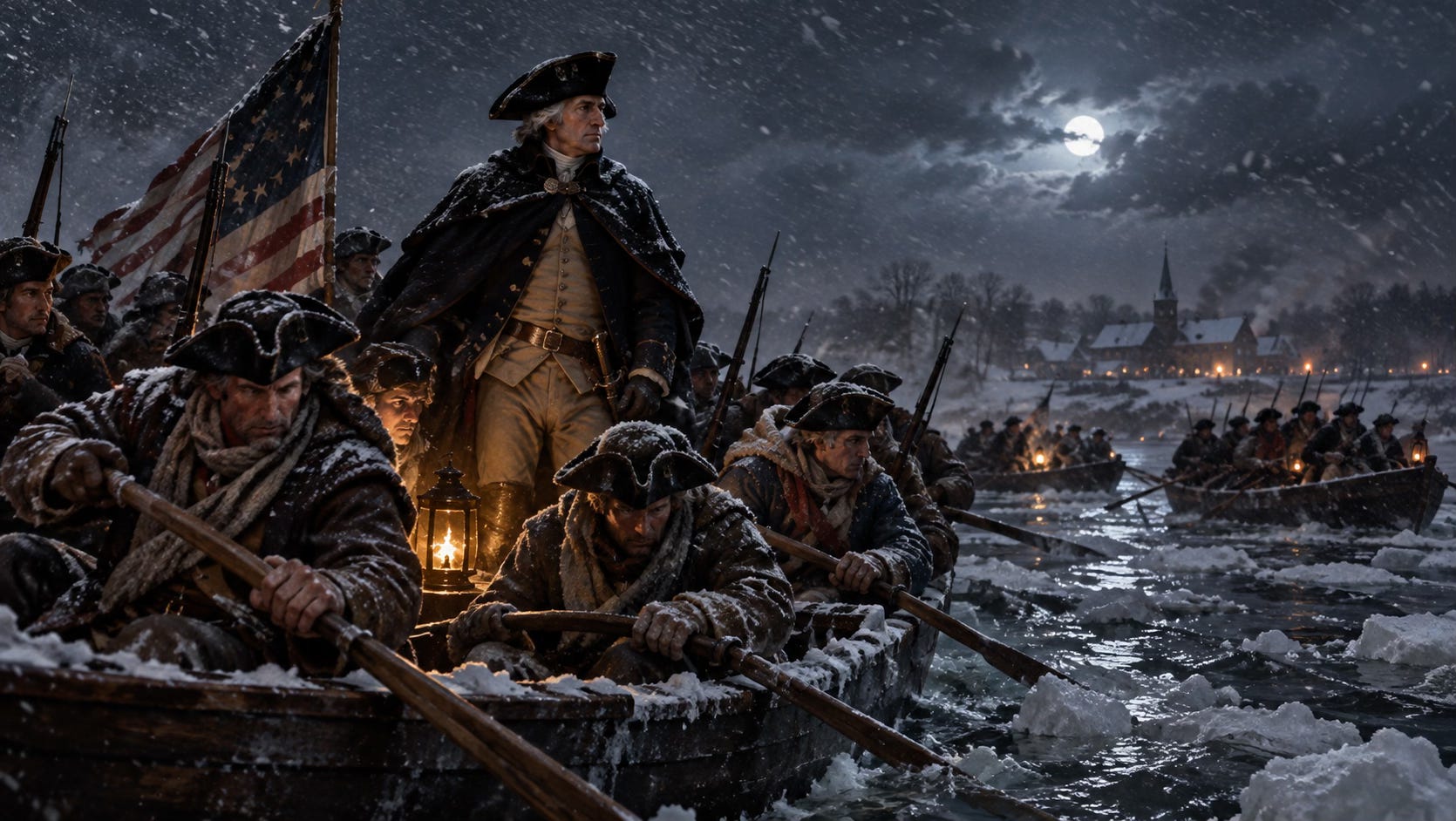
The countersign Washington issued for the night of December 25, 1776 was three words: Victory or Death.
It reads now like something written for a monument. It was not. It was a sober statement of the situation, and every officer who heard it understood exactly what it meant.
On December 31 the enlistments of most of the army expired. There was no realistic prospect of replacing those men. The Continental currency was collapsing. Congress had fled Philadelphia for Baltimore. The British held New York and most of New Jersey and were waiting for spring to finish the war.
Washington had about six days of army left.
So he decided to attack across a river, at night, in winter, with troops who had been beaten continuously for four months.
The plan called for three separate crossings of the Delaware, converging on the Hessian garrison at Trenton. Two of the three failed. Ewing could not get across at all. Cadwalader got some infantry over and could not land his artillery, and turned back.
Only the main column made it, and only because of who was rowing.
John Glover’s Marblehead fishermen were on the boats again. The same regiment that had taken nine thousand men off Long Island in the fog four months earlier now put roughly twenty-four hundred men, eighteen guns, and the horses to pull them across a river running with ice, at night, in a nor’easter that turned from rain to sleet to snow.
Twice in one year, the survival of the United States depended on a few hundred New England cod fishermen being unusually good at their trade.
The crossing ran hours behind schedule. Washington had wanted to be in position before dawn; the last troops were not across until after three in the morning. Then came a nine-mile march to Trenton on frozen roads in a blizzard.
Many had no shoes. The tracks in the snow were bloody, and this is one of those details that sounds like patriotic embroidery and is attested by men who marched in them.
Two soldiers sat down on the way and froze to death.
A message arrived that the powder was wet and the muskets might not fire. Washington’s response, as reported by an officer present, was to say that the men should use the bayonet, because he was resolved to take Trenton.
They hit the town around eight in the morning from two directions.
The legend is that the Hessians were drunk from Christmas. They were not. What they were was tired — they had been harassed by militia raids for days, they had been on alert repeatedly, and their commander, Johann Rall, had grown contemptuous of the American army and did not believe it capable of an offensive operation in that weather.
He was a brave officer and it was a reasonable assessment. It was also the only mistake that mattered.
Henry Knox’s artillery was in position at the head of the two main streets before the garrison could form. Hessian troops trying to organize in the open were swept by grapeshot down the length of the roads. American infantry came in through the houses and gardens on both flanks. Rall was shot from his horse and died the next day.
The fighting lasted somewhere under an hour.
Roughly nine hundred Hessians were captured. Around twenty were killed. American losses in the battle itself were essentially nil — a handful wounded, among them a young lieutenant named James Monroe, who took a musket ball in the shoulder that severed an artery and nearly killed him.
Then Washington marched them all back across the river the same day, because he had no intention of holding the town.
Militarily, Trenton was a raid on an isolated outpost. It destroyed a brigade. It did not defeat the British army, retake New Jersey, or alter the balance of forces in any measurable way.
What it altered was belief, and belief was the resource in shortest supply.
For four months the American army had done nothing but lose. Fort Washington, Fort Lee, the retreat across New Jersey — the accumulated evidence said the Continental Army could not stand against professional troops and that the war was a matter of time.
Trenton was evidence to the contrary, and it arrived at the precise moment the evidence was needed.
Militia began turning out again in New Jersey. Men whose enlistments were about to expire agreed to stay six weeks longer — Washington rode along the line and asked them personally, and a bounty helped, but the asking mattered. Congress, sitting in Baltimore, took a decision two days later that would test everything this series has been about, and that is the next essay.
There is a reason this particular episode became the founding image of American perseverance, reproduced in a famous and historically inaccurate painting that hangs in every schoolroom.
It is not that the odds were long. Long odds are common in war.
It is that a commander with six days of army left, who had been wrong about Fort Washington and knew it, chose to spend what he had left on a gamble rather than preserve it by doing nothing — and that a few thousand men with no shoes agreed to go with him.
If you enjoyed this article, you’ll love the documentary.
Thread of Liberty follows the entire thread of the American experiment — from ancient Rome and the Puritans, through the Revolution and the Constitution, to Tocqueville, Lincoln, Calvin Coolidge, and the modern Administrative State.
Watch the full feature documentary at ThreadofLiberty.com