
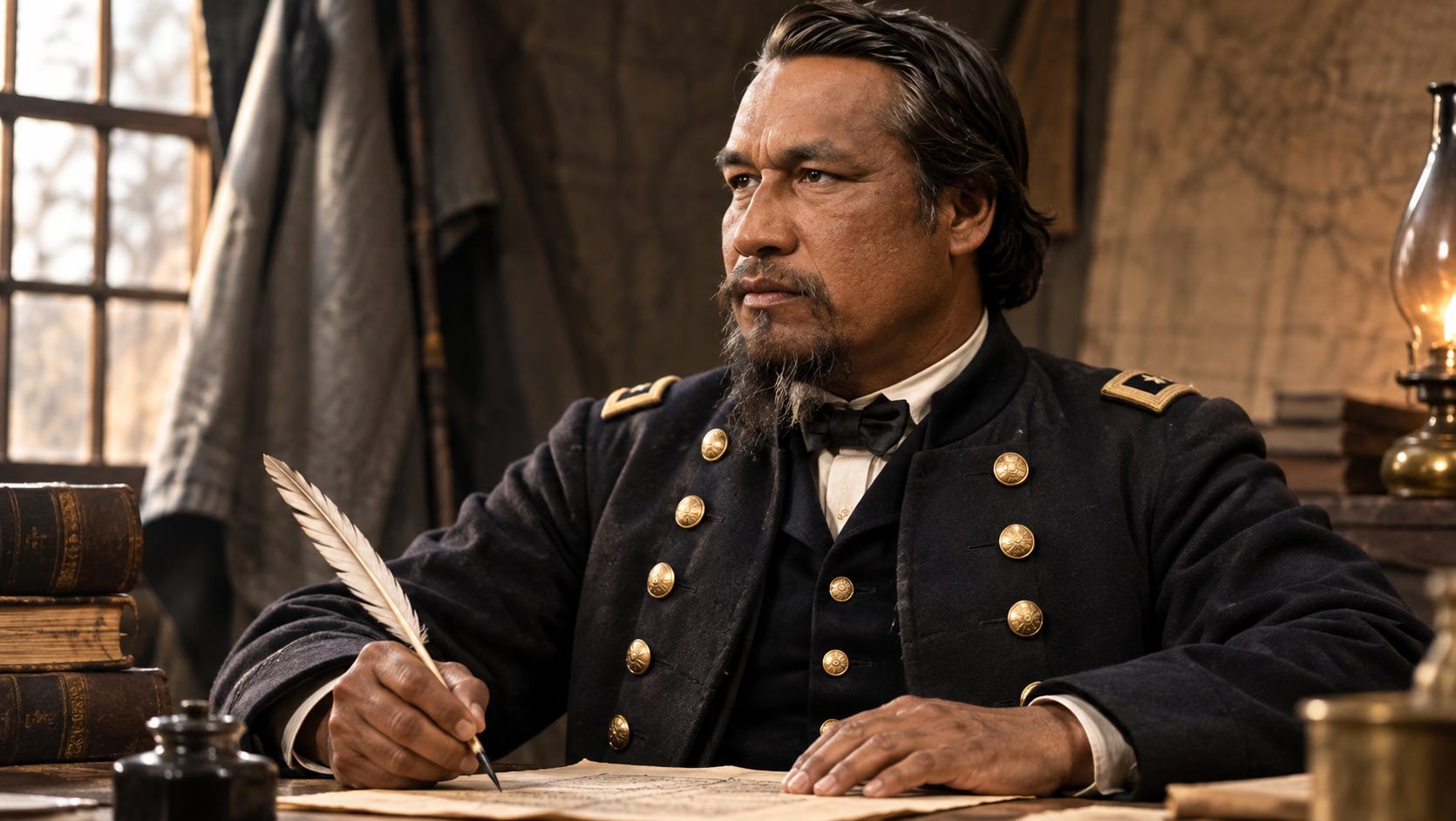
When Robert E. Lee walked into Wilmer McLean’s parlor at Appomattox Court House on April 9, 1865, he shook hands with the officers of Grant’s staff.
One of them was a broad-shouldered lieutenant colonel named Ely Parker.
He was a Seneca Indian.
By Parker’s own later account, Lee looked at him for a moment and said he was glad to see one real American there. Parker answered: “We are all Americans.”
The exchange comes to us from Parker and his family, so treat the exact words as tradition. What happened next is not in dispute. Grant’s terms had to be written out cleanly in ink, in multiple copies, and the job went to the officer with the best hand on the staff, who turned out to be Parker who then wrote the final copies of the surrender of the Army of Northern Virginia.
He was not, at that moment, a citizen of the country whose war he was helping to end.
Parker was born in 1828 on the Tonawanda Seneca reservation in western New York and given the name Hasanoanda. His family were leaders among the Seneca. He went to mission schools, learned English well enough to translate for Seneca delegations in Albany and Washington while still a teenager, and became the principal source for the scholar Lewis Henry Morgan, whose 1851 study of the Iroquois was dedicated to him. While still in his twenties he was raised to sachem, one of the hereditary chiefs of the Six Nations.
He wanted to be a lawyer. He read law for three years in an office in Ellicottville. When he applied to the New York bar he was turned away. Only citizens could practice, and Indians were not citizens.
So he became an engineer. He worked on the enlargement of the Erie Canal, and in the late 1850s the Treasury Department sent him to Galena, Illinois, to supervise construction of a federal customs house. In Galena he made a friend: a former Army captain clerking in his father’s leather goods store whose name was Ulysses S. Grant.
When the war came Parker tried to serve and was turned down. By his own account he was told it was a white man’s war and he should go home and tend his farm. He did not take that for an answer. In 1863, with Grant’s help, he was commissioned a captain of engineers and joined Grant’s staff. He stayed through Vicksburg, Chattanooga, the Wilderness, and Petersburg, and eventually became Grant’s military secretary.
After the war Grant became president and made Parker Commissioner of Indian Affairs, the first Native American to hold the post.
Here the story turns into one this publication knows well.
The Indian Office was one of the most corrupt agencies in the federal government. Contracts for food and supplies meant for the reservations were routinely padded, and agents grew rich while tribes went hungry. Parker set out to clean it up and to get supplies moving faster.
He ran straight into the bureaucratic machinery. A board of private citizens created to oversee the office fought him over authority. A former member of that board accused him of fraud. The House investigated in 1871 and found no corruption, only irregularities in emergency purchases Parker had made to get food to reservations before winter.
He was cleared but he resigned anyway. He had learned what every reformer of a federal bureaucracy learns: the system protects itself first.
He spent his last years in New York City as a clerk in the police department and died in 1895.
Native Americans were not recognized as citizens across the board until Congress passed the Indian Citizenship Act of 1924, twenty-nine years after Parker’s death and fifty-nine years after he wrote out the surrender at Appomattox.
Here is the lesson.
Parker was told no by the bar, by the War Department, and finally by a bureaucracy that would rather lose a reformer than reform. He kept showing up. He served a republic that had not yet decided he belonged to it, and he served it better than most of the men who never had to ask.
“We are all Americans,” he said, in a room full of men who had just spent four years killing each other over who counted.
It took the law another fifty-nine years to agree with him.
If you enjoyed this article, you’ll love the documentary.
Thread of Liberty follows the entire thread of the American experiment — from ancient Rome and the Puritans, through the Revolution and the Constitution, to Tocqueville, Lincoln, Calvin Coolidge, and the modern Administrative State.
Watch the full feature documentary at ThreadofLiberty.com
Wonderful story and I would not have ever known otherwise if it was not here.