
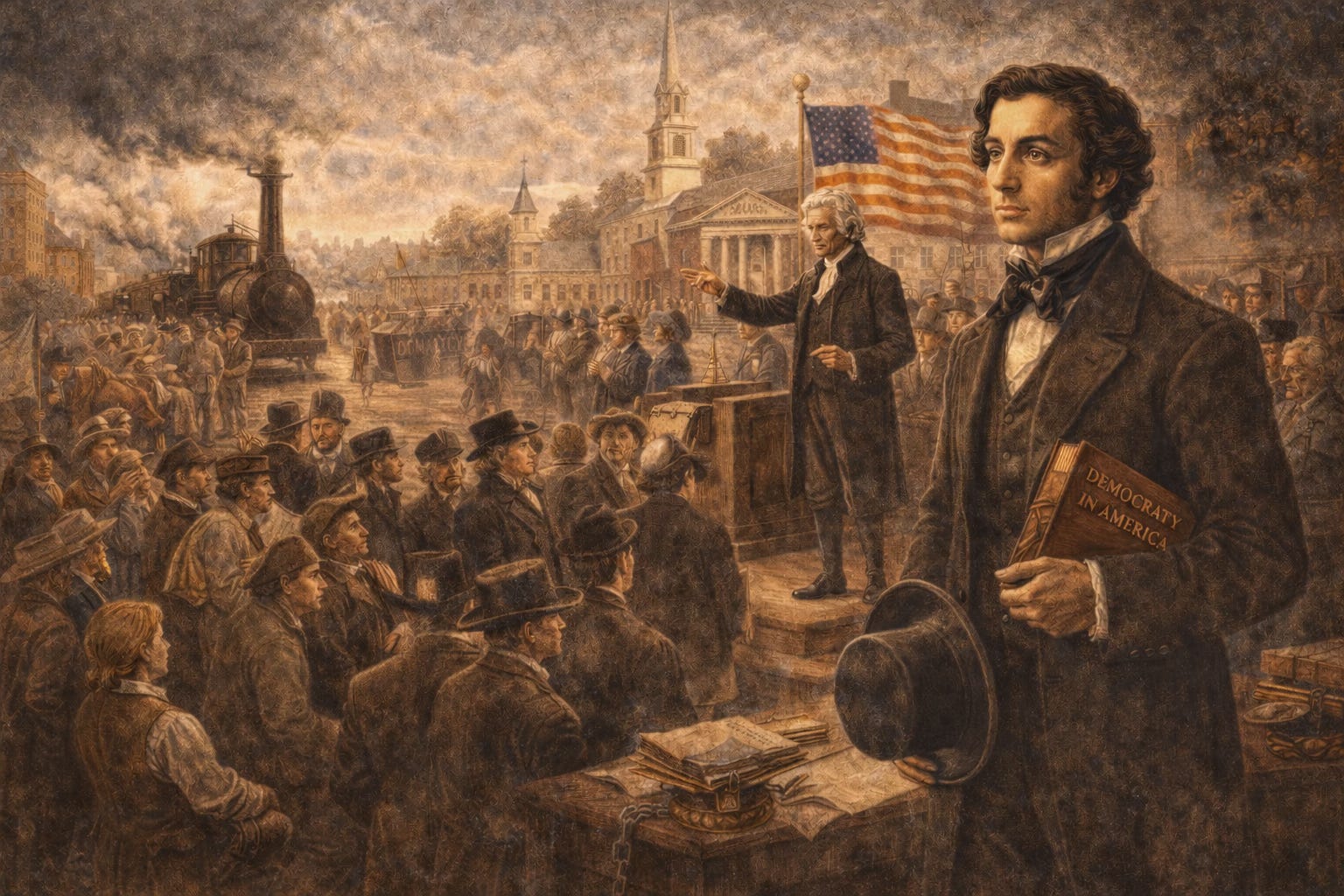
By the time Tocqueville stepped onto American soil, the Founders’ era was already fading into something new.
The republic still had their architecture—checks, balances, federalism, courts, legislatures.
But democracy—the social state—was accelerating.
This is the tension we’re going to live inside for the rest of this series:
Federalist vision vs. democratic reality.
The Founders—especially the more Federalist-minded among them—worried about faction, passion, and what Aristotle might call the instability of direct democracy.
They built representation as a filter. They built institutions to cool the temperature. That’s why we’re a representative democracy, not a pure democracy.
But by the 1820s and 1830s, America was democratizing in ways that made elite republicans nervous and ordinary citizens thrilled.
Property requirements for voting were falling.
Political participation was broadening.
Jacksonian democracy was rising.
The “common man” was becoming a political force not just rhetorically, but electorally.
And Tocqueville arrived at exactly this moment—when the Founders’ machinery still stood, but the democratic spirit was turning up the pressure inside it.
He found:
a people proud of equality,
suspicious of aristocracy,
hungry for prosperity,
restless and mobile,
intensely practical,
and surprisingly moral in private life compared to the freedoms they allowed in public life.
And here’s what he saw that’s so relevant now:
Democracy can produce greatness.
But it also produces pathologies.
It can create majorities that crush minorities—not always violently, sometimes socially.
It can create isolation in the name of independence.
It can produce “soft despotism,” where citizens trade responsibility for comfort while a managerial state quietly grows.
The Founders feared tyranny.
Tocqueville feared something subtler:
a nation of free people slowly becoming domesticated.
Which raises the question that kicks us into Act II:
Were the Whig safeguards sufficient for the democratic spirit?
Tocqueville is about to tell us.
Tocqueville was an observer and analyst not an advocate. In a number of ways he thought a traditional hierarchical monarchy would produce scientific and artistic results superior to a democracy. His work and insight can only be described as inspired. His analysis of the Supreme Court should give great pause to everyone regardless of political leaning.