
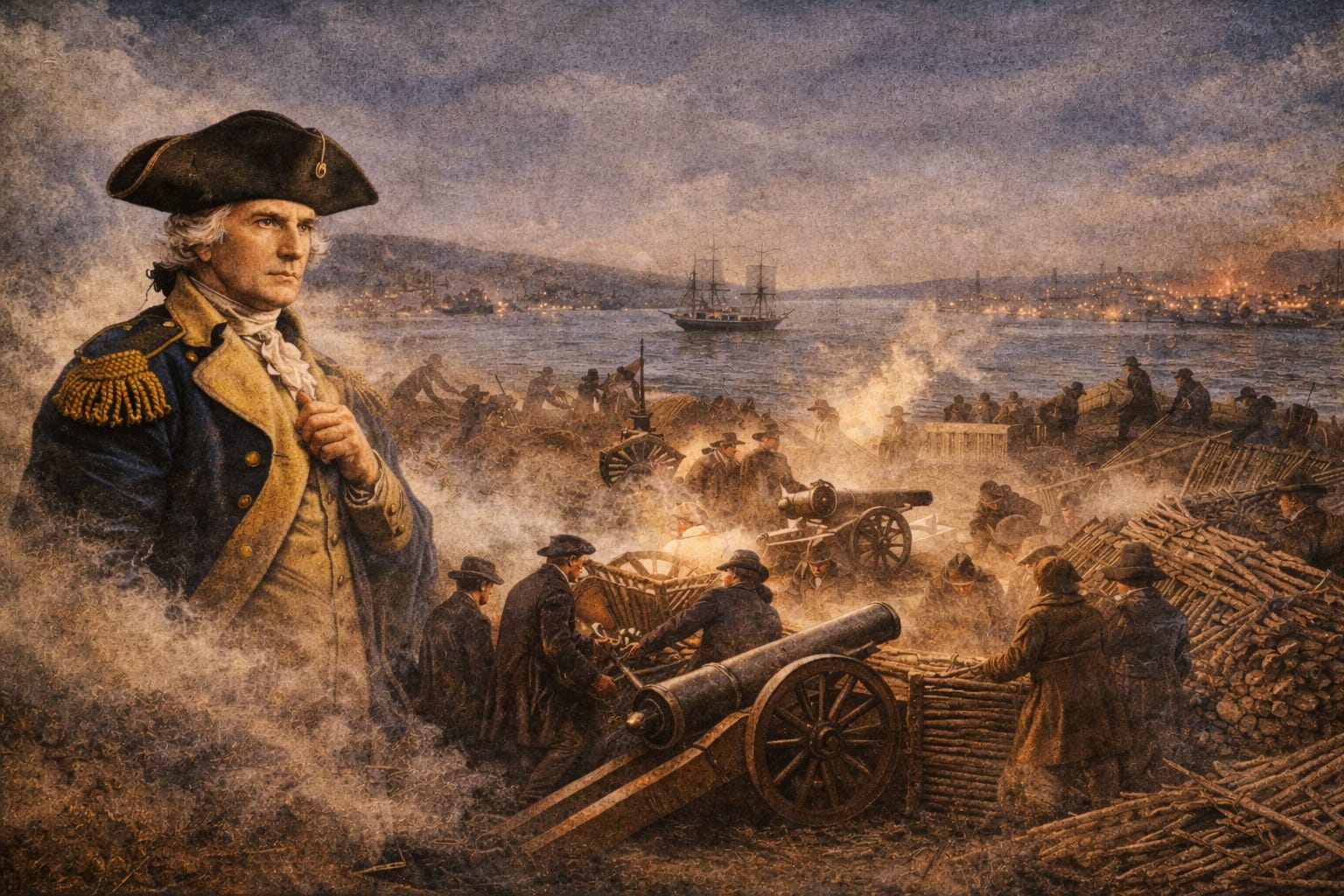
March 5 is when George Washington stole a march on the British and fortified Dorchester Heights — and in doing so, forced the British out of Boston.
Pretty epic story.
But epic in a way modern Americans often miss.
It wasn’t noise.
It wasn’t spectacle.
It was calculation.
A Siege Without a Solution
Since June 1775, after Bunker Hill, the British army had been bottled up in Boston. The American militia — and later the Continental Army — surrounded them in what became known as the Siege of Boston.
But surround is not the same thing as defeat.
Washington arrived in July 1775 and quickly realized the problem. The army was enthusiastic but undertrained. Powder was scarce. Discipline was uneven. The British fleet controlled the harbor.
In a letter that autumn, Washington admitted bluntly:
“Our Situation is truly distressing.”
He understood that without heavy artillery, Boston could not be retaken.
That changed in January 1776, when Henry Knox completed what Knox later called a “noble train of artillery.” Knox hauled 59 cannon and mortars over 300 miles from Fort Ticonderoga to Cambridge in the dead of winter. He crossed mountain ranges, frozen rivers, lowered cannons down cliffs, deeply determined to return the heavy cannon to Washington.
It was an act of logistics bordering on madness.
But succeed Knox did.
And it was a turning point.
The Geography of Leverage
Boston is not merely a city. At the time of the Revolution it was a peninsula surrounded by water and narrow land connections.
Dorchester Heights sits south of the city and commands the harbor and the town.
Whoever held those heights could bombard British ships and positions inside Boston.
Washington knew this.
But he also knew that attempting to occupy the Heights invited British counterattack — likely by water, where tides dictated movement.
On March 2, 1776, Washington wrote to Artemas Ward:
“After weighing all circumstances of tide, etc., and considering the hazard, we are of the opinion that the attempt shall be made.”
Notice the language.
Not confidence.
Hazard.
Washington was not charging into glory. He was measuring risk.
He even acknowledged the possibility of failure, warning that if the British seized Dorchester first, “we shall be much injured.”
This was not inevitable victory.
It was strategic gamble.
The Night Move
On the evening of March 4 — into the early hours of March 5 — American troops began the operation.
To distract the British, Washington ordered a heavy bombardment from Cambridge. British attention fixed north.
Meanwhile, thousands of American soldiers quietly marched south with artillery and pre-built fortifications. The ground was frozen too hard to dig effectively, so they used chandeliers (wooden frameworks), fascines (bundled brush), and portable earthworks.
By dawn on March 5, British General William Howe looked up and saw something astonishing.
Overnight, American cannon dominated the harbor.
Howe reportedly exclaimed that the rebels had done more in one night than his army could accomplish in months.
He prepared a counterattack.
Then a storm hit.
A violent nor’easter scattered plans and made landing troops nearly impossible. The window for British assault closed.
Within days, Howe concluded that holding Boston was untenable.
On March 17, 1776, British forces evacuated the city.
Washington entered without firing a major shot.
Not a Battle — A Checkmate
There was no climactic battlefield victory.
No annihilation.
No surrender ceremony.
Washington had altered the geometry of power.
He didn’t destroy the British army.
He made staying irrational.
In a later reflection, Washington wrote:
“The ministerial troops evacuated the town of Boston without destroying it.”
Which, given the stakes, was no small mercy.
Why This Matters at 250
We like to tell the Revolution as a series of explosions — Lexington, Bunker Hill, Saratoga, Yorktown.
But Dorchester Heights reminds us that the Revolution also advanced through determination, engineering, patience, and timing.
Washington understood something essential to self-government:
Freedom is not secured by passion alone.
It requires adults who can read terrain, calculate tides, measure hazards, and act when leverage appears.
He did not control:
The weather.
The British navy.
The duration of enlistments.
He controlled timing.
And that was enough.
March 5 is epic not because it was loud.
It’s epic because it was disciplined.
Because sometimes the most decisive victories are the ones where your opponent decides not to fight.
At 250 years, that’s a lesson worth revisiting.
The experiment continues.
Henry Knox's efforts should be taught more in our schools. He was an incredible patriot.
I want to say something, and I hope it's not taken the wrong way, but a large portion of this post feels like it was written by AI. I'm not saying it was, but it feels that way. I just want to make you aware, so you can modify if you choose. Where it really became apparent to me was at "Not a battle - a checkmate".
Quite an interesting and timely article.