
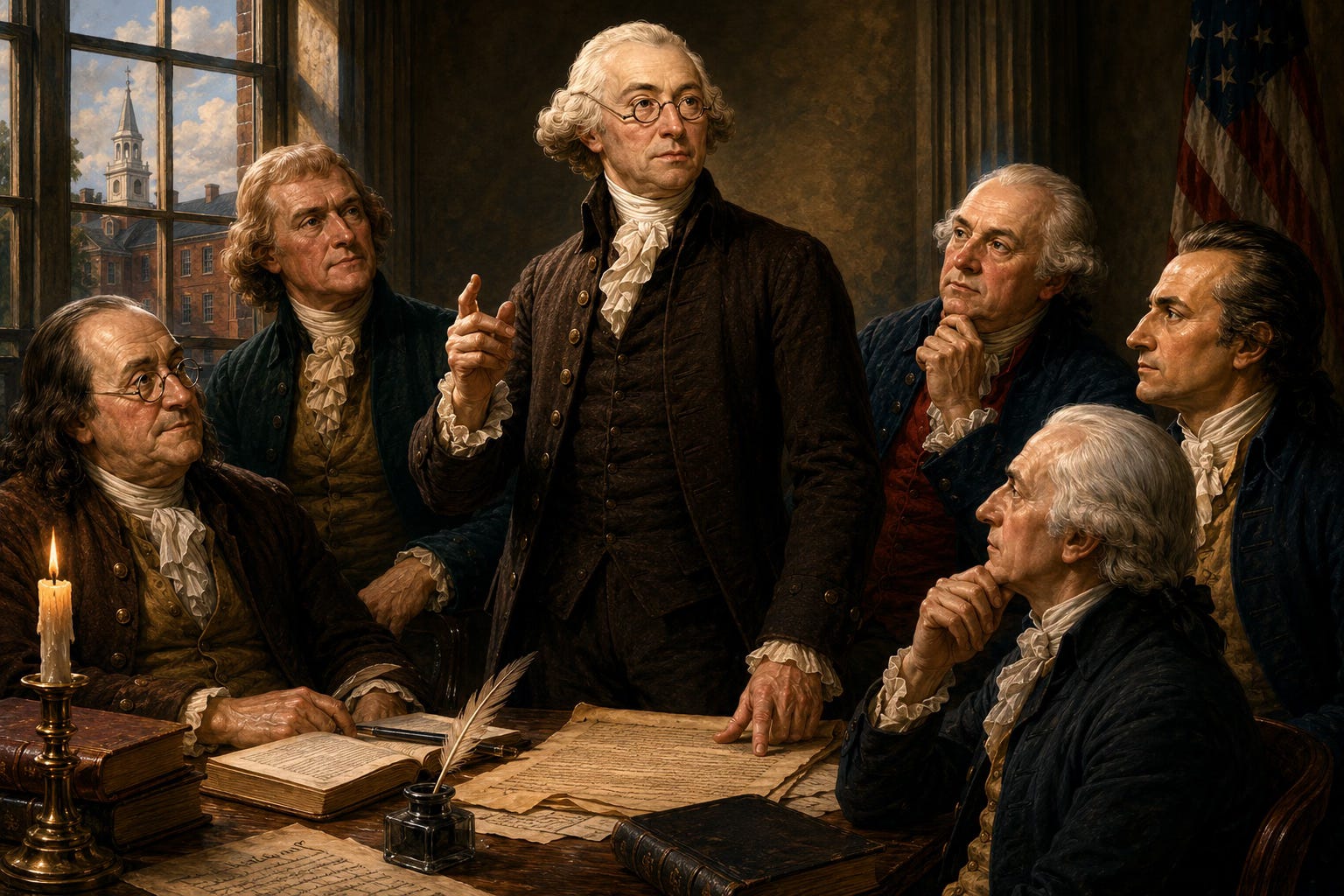
Modern politics suffers from remarkable confidence; “chronological snobbery” as C.S. Lewis describes it.
Every generation believes its problems are unprecedented and its technology unique, its politics entirely new.
The Founders disagreed because they believed that though times may change, there is always one constant throughout history: human nature.
Which explains why their libraries were filled with historical works: Plutarch, Livy, Polybius, Cicero (who John Adams, somewhat obsessed with Cicero’s writings and speeches, affectionately referred to as “Tully”), Tacitus, Aristotle.
Not necessarily because they loved antiquity but because they loved patterns.
History became their laboratory. Athens taught what pure democracy becomes without restraint. Rome demonstrated how republics slowly consolidate power. England illustrated both liberty and corruption simultaneously.
The Founders were not collecting quotations from the ancients. They were conducting political science.
Madison spent months before Philadelphia reading books about nearly every republic from history. Not searching for inspiration per se but searching for failure: Why did republics in the past fail? What broke? When? Why?
That research of human nature and failed republics shaped the Constitution more than many Americans realize. Madison’s conclusions from his studies were that factionalism, and eventually one faction gaining enough power to crush the others, was why many republics in the past had failed. So his recipe for success was to set faction against faction and through the machinery of the republic (the separation of pwoers) never allow one faction to gain too much power.
The Founders expected future citizens to continue that habit of studying and applying history.
History wasn’t nostalgia for our Founders. It was their roadmap to the future.
A republic without historical memory eventually repeats historical mistakes.
Modern societies should study history more carefully. There is a circular nature to it as we progress through time: we make technological advances and scientific breakthroughs, yet many times repeat the same mistakes of previous generations because of our flawed human nature.
The Founders were trying to avoid past generations’ mistakes when it came to republics failing. We’d do well to follow their example and become better students of history.
If you enjoyed this article, you’ll love the documentary.
Thread of Liberty follows the entire thread of the American experiment—from ancient Rome and the Puritans, through the Revolution and the Constitution, to Tocqueville, Lincoln, Calvin Coolidge, and the modern Administrative State.
it is a grave error to attribute the (ulterior) motives of those who are motivated
and driven to grasp the Brass Ring of public power to "human nature"
The sweeps of his-story are not driven by "human nature" at all but by the
proclivities habituations preferences and psychosociopathies of the tiny elites
who fraudulently maneuver and manipulate their way into positions of power
in order to abuse that power to leverage their personal and ideological psychopathies
over millions of people.
The founders did not read his-story to be better founders or governors, but to engage
in their narcissistic egotistical dick-wagging
If their "reading of his-story" led them to:
Fraudulently portray "We the People" as pertaining to or even representing the unwashed hordes...
when in fact that term referred to the wealthy white male property-owning slave-owning members of the rentier class who participated in the whole Imperial Colonial project ...
Not as is claimed to "heroically cross the waters to the Promised Land and even more heroically
hew a civilization from the wilderness in order to provide a Land of Liberty and Prosperity for people who could flee the old world tyrannies
It quickly becomes evident that their reading and education was in the art of sophistry and fabrication
Political order depends less on universal agreement than on a settled answer to one question: who gets the final word when agreement fails?