
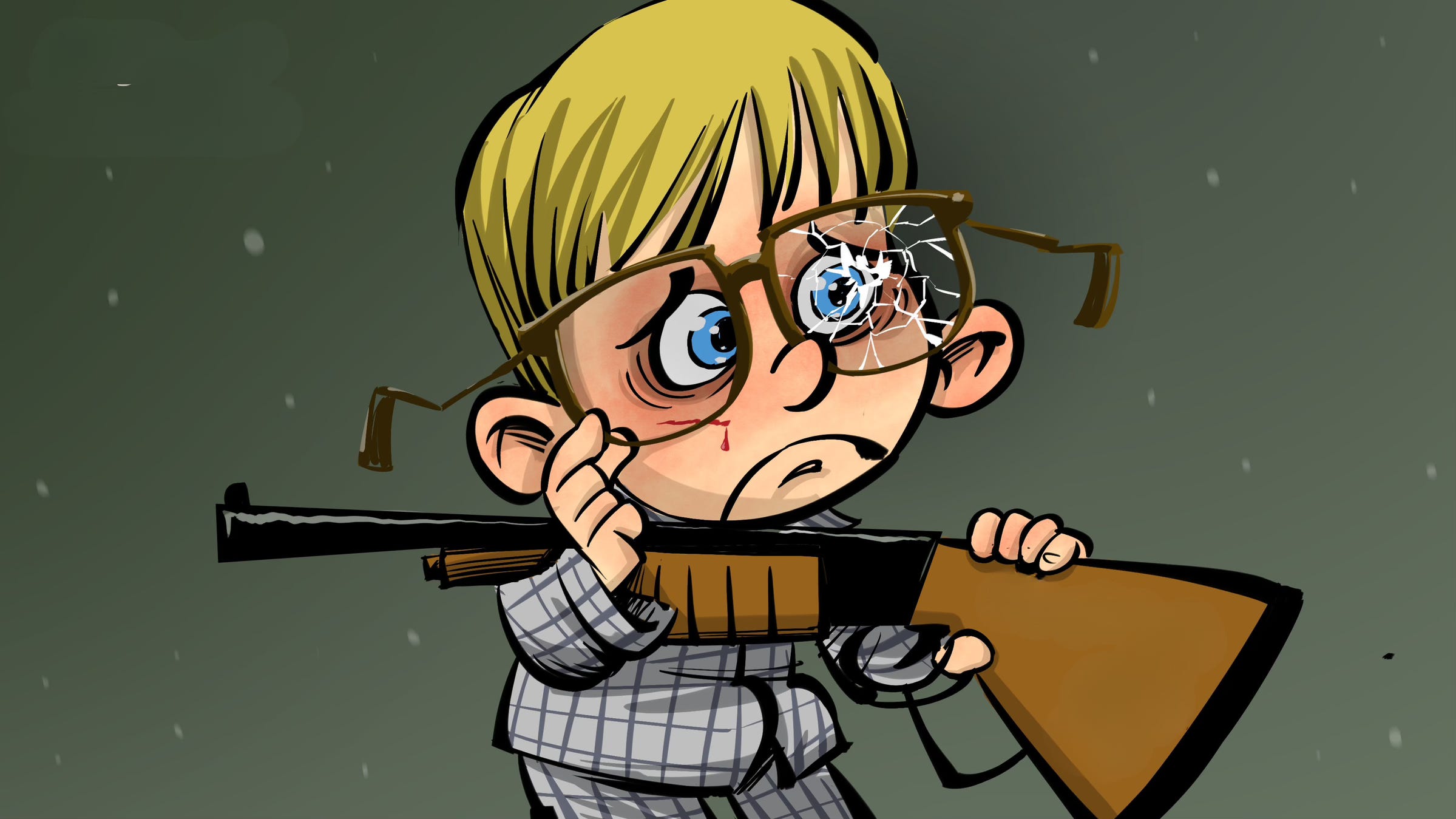
A Christmas Story looks like nostalgia—tinsel, BB guns, leg lamps, Midwestern charm.
But underneath the humor is one of the clearest cultural warnings we’ve ever put on film:
A society that treats citizens like children will eventually raise children who never learn to be citizens.
Ralphie’s quest for a Red Ryder isn’t about a toy.
It’s about the slow suffocation of agency under an emerging worldview that treats risk as harm, independence as danger, and responsibility as something the system should remove—not cultivate.
In other words: A Christmas Story is the origin tale of American safetyism — the soft, smiling face of Leviathan.
“You’ll shoot your eye out!” — The First Commandment of Safetyism
The line is funny because it’s everywhere in the film.
Everyone—his mother, his teacher, the department-store Santa—delivers the same script: you can’t handle the thing you want.
Not because Ralphie is incapable, but because the adults have adopted a worldview that treats fear as wisdom.
This is exactly how the administrative state talks to grown adults today:
“That’s dangerous.”
“Leave that to the experts.”
“We can’t trust people with that level of freedom.”
“It’s for your own safety.”
“Better safe than sorry.”
“We know best.”
Ralphie just wants a BB gun.
Leviathan insists on a national posture that treats citizens as liabilities.
A Christmas Story Shows the Birth of the Infantilized Citizen
The adults in the movie aren’t tyrannical — they’re cautious, anxious, and institution-shaped.
They represent a society beginning to shift from:
agency → protection
responsibility → supervision
competence → compliance
The result?
Every desire is met with a warning.
Every aspiration with a caution.
Every act of independence with a reminder that risk is dangerous and must be avoided at all costs.
This is Leviathan’s psychological ecosystem: a culture that exchanges strength for safety and ends up with neither.
The Movie Isn’t About a Gun. It’s About Permission.
Ralphie’s longing isn’t really for a Red Ryder.
It’s for the right to want something without being scolded.
The BB gun symbolizes:
self-reliance
responsibility
independence
the transition from boy to young man
the dignity of learning through doing
The adults’ resistance symbolizes Leviathan’s central message:
“We do not trust you with your own life.”
That’s the core of safetyism: a governing philosophy that treats maturity as a threat.
The School, the Store, the Family — All Reading From the Same Script
One of the most telling elements of the film is that Ralphie receives identical warnings from completely different institutions.
This reveals something subtle:
The culture has been standardized.
The narrative has been synchronized.
Risk-aversion has been institutionalized.
He didn’t live under a bureaucratic state yet — but the precursor was already there: a society training its population to think like a bureaucracy.
Every adult is a miniature regulator.
Every warning is a micro-rule.
Every reaction is conditioned.
This is how Leviathan grows — from culture first, law second.
Ralphie’s Fantasy Scenes Are the Only Moments of Real Freedom
Whenever Ralphie daydreams, he imagines himself as competent:
a sharpshooting hero
a protector
someone capable of defending home and family
Why?
Because no one around him believes he can be.
His fantasies are the last refuge of an unmanipulated imagination — a place where self-governance still exists.
Leviathan’s great project is eliminating those internal worlds entirely.
The Famous Soap Scene — Social Shame as Regulation
When Ralphie says the forbidden word, he’s punished with soap.
But the real punishment isn’t the physical act — it’s the shame.
This is how safetyism enforces compliance:
Not through force, but through social pressure and moral messaging.
“You should feel bad for wanting independence.”
“You’re irresponsible for taking risks.”
“You’re dangerous for thinking you can handle things yourself.”
Ralphie isn’t being punished for misbehavior.
He’s being conditioned.
The Ending Proves the Truth the Adults Never Admit
Ralphie gets the BB gun.
He uses it.
He handles it.
He learns from it.
He takes responsibility.
He doesn’t shoot his eye out.
He grows.
The adults were wrong.
And that’s the point the culture never took seriously.
The Real Message Buried Under the Snow
A Christmas Story is not a sentimental portrait of childhood.
It is a snapshot of a culture shifting toward paternalism, fear, and the belief that the job of adults is not to raise strong kids — but to raise safe ones.
That mindset didn’t remain cultural.
It became political.
It became bureaucratic.
It became Leviathan.
And now, in a nation of Ralphies and rule-makers, the system repeats the same line, louder and louder:
“You’ll shoot your eye out!”
“You’ll shoot your eye out!”
“You’ll shoot your eye out!”
The movie’s great irony is this:
Ralphie’s story is the last time America believed children could grow into capable adults.
Since then, the warnings have only gotten louder.
And Leviathan is more than happy to keep saying them.